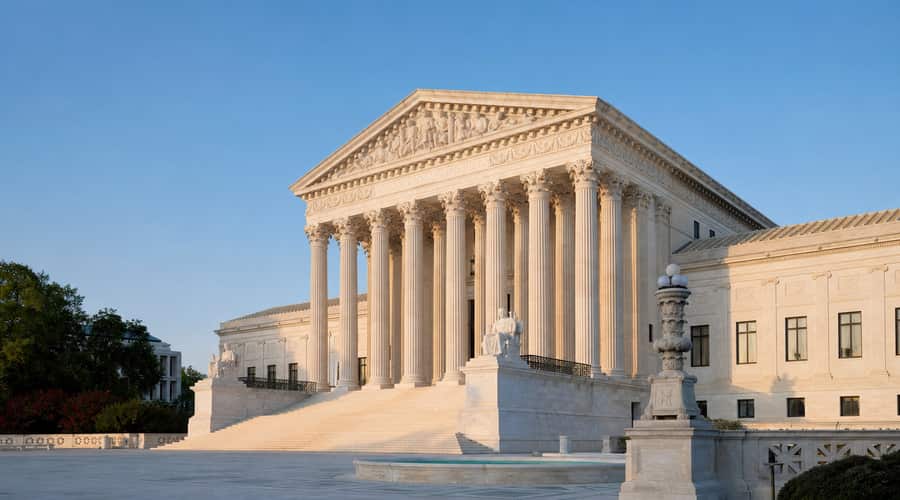
The Supreme Court ruled today that border officers do not need heightened proof to deny re-entry to green card holders suspected of crimes, handing the Trump administration its fourth major immigration win of the term.
Justice Clarence Thomas, who turned 78 today, authored the majority opinion in Blanche v. Lau, a 6-3 decision that clears the way for Customs and Border Protection officers to treat returning lawful permanent residents as new applicants for admission whenever those residents are suspected of committing a crime involving moral turpitude, without first meeting a "clear and convincing evidence" standard. All five other conservative justices joined him. The three liberal justices dissented.
The case arose from a 2012 border encounter involving Muk Choi Lau, a lawful permanent resident who traveled abroad while facing a state charge of trademark counterfeiting. When Lau returned, CBP placed him on immigration parole for deferred inspection rather than waving him through as a returning resident. That procedural distinction matters enormously: an LPR treated as a returning resident gets the benefit of the doubt and formal deportation protections. An LPR reclassified as an applicant for admission faces the full inadmissibility process, where the burden of proof shifts onto the individual, not the government.
Thomas and the majority held that the Immigration and Nationality Act does not require border officials to first prove by clear and convincing evidence that Lau had committed the qualifying offense before reclassifying him. The government only needed to determine, based on the pending charge and available information, that he had committed a crime involving moral turpitude. That is a substantially lower bar, and the ruling cements it as the operative standard at every port of entry in the country.
Before today, there was genuine legal ambiguity about how much evidence a CBP officer needed before downgrading a returning green card holder's status at the border. Courts had split on it. Thomas's opinion resolves the split decisively in the government's favor. Under the ruling, a pending charge, a prior conviction, or other indicators of a qualifying offense are enough. Officers no longer need to conduct what would amount to a mini-trial at the port of entry before routing a suspected criminal into removal proceedings.
For the Trump administration, the practical effect is immediate. DHS now has explicit Supreme Court backing to flag and detain green card holders with criminal records or open charges who travel internationally, a population that DHS has been targeting aggressively under its broader noncitizen vetting push. The administration filed briefs in the case urging the Court to take an expansive view of executive enforcement discretion, and Thomas gave them exactly that.
The ruling also arrives as the administration prepares its enforcement posture heading into the 2026 midterms, where immigration remains the defining issue. Three prior Supreme Court wins this term had already expanded deportation authority and narrowed judicial review of removal orders. Blanche v. Lau is the capstone: it locks in CBP's front-line discretion before a case ever reaches an immigration judge.
Jackson's Dissent and the Stakes for 12.8 Million Residents
Justice Ketanji Brown Jackson's dissent was pointed. She argued that the majority's reading lets the government classify an LPR as "seeking admission" first and supply the legal justification afterward, inverting the statutory scheme Congress designed. She warned the Court had handed the executive "a massive blank check" to upend the lives of permanent residents before any criminal conviction. Justices Sotomayor and Kagan joined her.
Jackson's concerns are not purely theoretical. The ruling touches roughly 12.8 million lawful permanent residents currently in the United States. Any of them who travel abroad while facing an unresolved charge, or even with a prior conviction on their record, now faces the prospect of being reclassified at the border and placed into inadmissibility proceedings rather than being treated as a returning resident with established rights. Immigration attorneys have noted that the shift in burden of proof is not a minor procedural tweak; in removal proceedings it can be the difference between staying in the country and being deported.
Critics will argue, as Jackson did, that being accused of a crime and having committed one are different things, and that the majority blurs that line. The majority's answer is that CBP officers are not adjudicating guilt. They are making a threshold determination about which legal track applies at the border, a determination Congress gave them discretion to make. Thomas held the statutory text supports that reading, and five justices agreed.
The next question is how aggressively DHS moves to operationalize the ruling. The administration has signaled it wants border officers to use every available enforcement tool, and Blanche v. Lau just added a confirmed, court-backed one. Watch for DHS guidance in the coming weeks, and for legal challenges to specific detentions that will test how broadly agencies apply today's decision.
Also read: ICE Nabs Illinois Teacher Who Allegedly Drove Tren de Aragua Killers to Chicago Party • The judge who killed the DOJ's Minnesota probe donated to immigrant legal aid groups for years • Federal grand jury indicts 15 Minneapolis antifa members in anti-ICE conspiracy