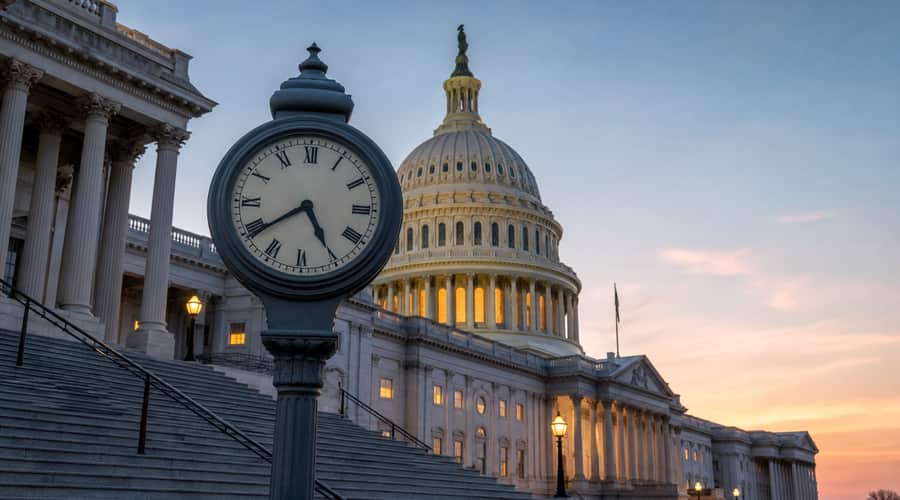
The House voted 308-117 on Tuesday to end the twice-yearly clock change and lock the country onto daylight saving time year-round, sending Rep. Vern Buchanan's Sunshine Protection Act to a Senate that has buried it before.
The House did something it has failed to do for years. Members voted 308-117 on Tuesday, July 14, to pass the Sunshine Protection Act, which would end the ritual of springing forward and falling back and put the country permanently on the time currently observed from March to November. Rep. Vern Buchanan, R-Fla., has carried the bill through multiple Congresses. President Trump pushed it publicly this time, and the bill actually moved.
The margin says something too. Three hundred eight ayes, 117 nays, in a chamber that can barely agree on a continuing resolution. States would keep the option to exempt themselves before the change takes effect, the same carve-out Arizona and Hawaii already use to sit out the clock switch entirely. For everyone else, no more losing an hour of sleep in March and no more sunset at 4:30 in December.
This bill is not new. Buchanan has introduced versions of it going back to 2018, and it has died in committee or on the floor every time. What changed this year was the president weighing in directly. Trump wrote that the clock switch costs "Hundreds of Millions of Dollars" a year in lost productivity and confusion for "people, Cities, and States," and called the biannual ritual a "ridiculous, twice yearly production" that should end. Members of both parties who had let the bill languish for years found themselves voting on it within months of that pressure landing.
That is worth sitting with. Congress had every reason to act on this before now. Sleep researchers, retailers, parents, farmers, all of them have complained about the switch for decades. It took a president saying so, loudly and repeatedly, to actually force a floor vote. Say what you want about Trump's style, it gets bills moving that would otherwise sit untouched.
The Senate already killed this once
Here is the catch. The Senate is not a formality. It passed its own version of the Sunshine Protection Act by unanimous consent back in March 2022, only to watch it stall in the House and die at the end of that Congress. The order is reversed this time, but one obstacle has not moved. Sen. Tom Cotton, R-Ark., blocked a fast-track vote on the Senate companion bill last fall, warning that permanent daylight saving time would leave parts of the country facing sunrises after 9 a.m. in the dead of winter, with kids waiting for school buses in the dark. Cotton has not signaled he has changed his mind, and under Senate rules a single senator can hold up unanimous consent indefinitely.
The bill does have real Senate backers. Marco Rubio, R-Fla., and Ed Markey, D-Mass., have co-sponsored Sunshine Protection Act versions together for years, an odd-couple pairing that shows this fight does not split cleanly along party lines. It splits along geography and chronotype instead. Lawmakers from the Sun Belt tend to want more evening light. Lawmakers from the northern tier worry about kids walking to school before sunrise.
Adding to the muddle, Reps. Pat Harrigan, R-N.C., and Mary Gay Scanlon, D-Pa., introduced a competing measure this month called the Sunshine for Our Kids Act, which would make standard time, not daylight saving time, permanent nationwide, while letting individual states opt into daylight time if they choose. Their argument is the mirror image of Buchanan's: morning light matters more for children's health and safety than an extra hour of evening sun.
So the House has now settled on an answer. The Senate has two competing bills, a senator willing to block either one, and a president publicly rooting for the House's version to become law. Majority Leader John Thune has not committed to a floor vote or a timeline. Whether Cotton relents, whether Rubio and Markey can round up 60 votes, and whether Trump keeps applying pressure once the news cycle moves on will decide whether Americans ever set their clocks for the last time. For now, the twice-yearly ritual stays exactly where it was a year ago: alive, unpopular, and waiting on the Senate.
Also read: Blanche Enters His Confirmation Hearing Backed by 670,000 Officers • House conservatives end blockade as Johnson strikes voter ID deal • Consumer prices fell 0.4% in June as inflation cooled to 3.5%