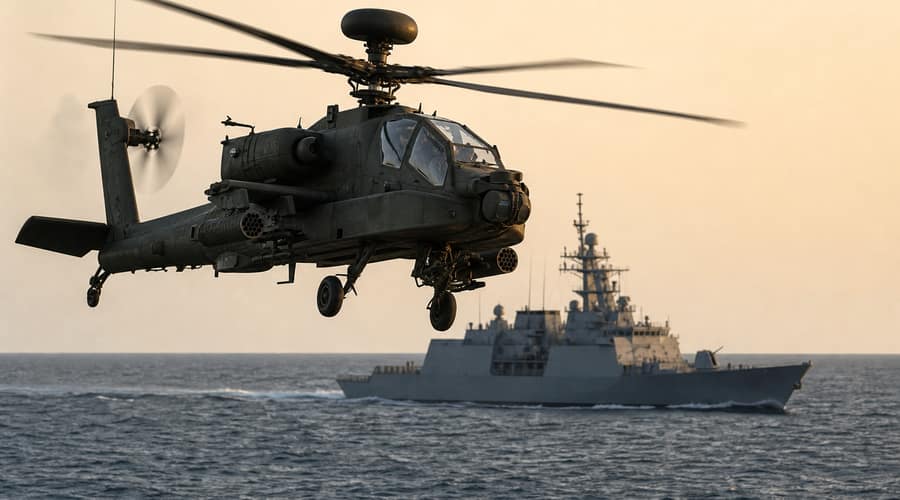
Iran shot down a U.S. Army Apache helicopter patrolling near the Strait of Hormuz, President Trump confirmed Tuesday, as he vowed a response while nuclear negotiations with Tehran hang in the balance.
The AH-64 Apache went down off the coast of Oman on Monday evening, becoming the first Apache lost since U.S.-Iran hostilities escalated earlier this year. Trump stated publicly that Iran had fired on the aircraft while it was on patrol. "The United States must, of necessity, respond to this attack," he said, without specifying what form that response would take. "The pilots are fine," he added.
Both crew members survived. They were rescued by an unmanned surface vessel operated by Task Force 59, the U.S. Fifth Fleet unit based in Bahrain, in what military officials told CBS News was the first rescue of its kind ever conducted by the American military using a sea drone. CENTCOM confirmed in a Tuesday statement that the two soldiers had been recovered and were in stable condition. The command added that "the cause of the incident is under investigation," stopping short of Trump's direct public attribution of the shoot-down to Iran.
The president's charge that Iran deliberately targeted a U.S. military aircraft carries serious consequences. U.S. forces had deployed AH-64 Apaches and A-10 attack aircraft to the Hormuz area to reinforce the American presence in one of the world's most contested waterways, according to reporting by Army Recognition. Those helicopters were tasked with patrol and force projection near a strait that handles roughly a fifth of global oil supply. Losing one to hostile fire, if confirmed, marks a significant escalation.
The shoot-down arrived at one of the most delicate moments in U.S.-Iran relations in years. Trump told reporters Tuesday that Washington and Tehran were "very close" to a deal that "will not in any way, shape or form allow nuclear weapons" and would reopen the Strait of Hormuz to commercial shipping "immediately," according to CNBC. He said he expected an agreement within "two or three days."
Trump then explained his caution about a wider strike. Bombing Iran "would keep the Strait closed for months, kill many people," he said, signaling a clear preference for a signed agreement over full military escalation. That framing suggests the administration is looking for a response calibrated to answer the downing of a U.S. aircraft without collapsing months of high-stakes diplomacy. A targeted strike on Iranian air defense systems could satisfy the political requirement to act while preserving a lane back to the negotiating table.
A central unknown is whether Tehran's leadership authorized the shoot-down or whether a military unit acted without orders. That distinction will shape both what the U.S. does next and whether the nuclear talks survive. Iran and Israel exchanged direct strikes over the weekend in their first such exchange in months. Trump brokered a renewed ceasefire just one day before the Apache went down, making the timing difficult to read as coincidence or accident.
What the Strait Means
Roughly 20 percent of global oil exports transit the Strait of Hormuz daily, and disruptions there move energy markets immediately. Just the News has reported that ongoing tensions are already affecting trade flows through the waterway, applying upward pressure on oil prices that American consumers pay at the pump. The U.S. military presence in the region, including the Apache patrols, is explicitly designed to keep that corridor open and signal to Tehran that the strait is not available as diplomatic leverage.
The administration's next moves will be watched closely in energy markets and allied capitals alike. A strike on Iranian air defense systems would demonstrate resolve but risk unraveling the nuclear talks at their most critical stage. A restrained or proportional response holds the diplomatic track intact but invites further Iranian probing of American boundaries. Trump's self-imposed two-to-three-day deal deadline means whatever response he orders, or withholds, will land alongside an expected announcement from the negotiating table. The Apache crew is safe. The harder decisions are just beginning.
Also read: Pentagon flags Alibaba, BYD and Baidu as Chinese military companies • Federal watchdog finds 101 UNRWA staff were Hamas fighters on October 7