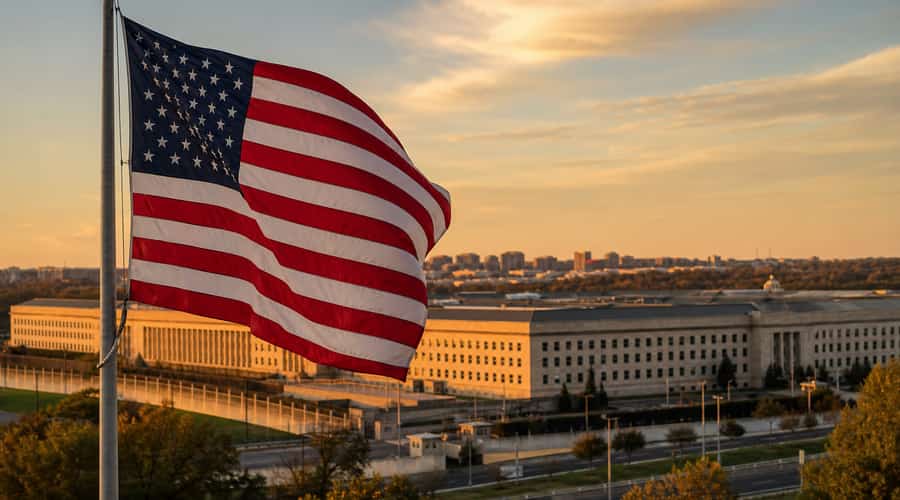
The Pentagon formally designated Alibaba, BYD, and Baidu as Chinese military companies, setting a countdown clock on U.S. defense contractors that do business with any of the three firms.
The Defense Department added three of China's most recognizable commercial brands to its Section 1260H list of Chinese military companies on June 8, citing their affiliations with China's Ministry of Industry and Information Technology as evidence of participation in Beijing's military-civil fusion strategy. The move, confirmed by Bloomberg, NPR, CNBC, CBS News, and Fortune, carries concrete procurement consequences that reach well beyond the Pentagon itself.
Under federal law, the Defense Department is barred from contracting directly with newly listed companies starting later this month. A second, broader prohibition takes effect in June 2027, blocking the Pentagon from procuring the firms' products or services through third-party intermediaries. That extended reach means American companies with defense contracts will need to restructure any supply chain relationships involving Alibaba's cloud platform, BYD batteries, or Baidu's artificial intelligence tools. The updated list now covers 188 Chinese entities, up from roughly 130 on last year's version. This year's additions also include electric vehicle maker NIO, biotech firm WuXi AppTec, and robotics companies Unitree and RoboSense.
All three marquee companies pushed back immediately. Alibaba issued a formal statement: "There's no basis to conclude that Alibaba should be placed on the Section 1260H List. Alibaba is not a Chinese military company nor part of any military-civil fusion strategy." Baidu vowed to use "all options" to seek removal. BYD likewise disputed the designation, according to NPR. Markets absorbed the news with modest declines: Baidu's American depositary receipts fell 2.1 percent, Alibaba dropped 0.8 percent, and BYD slid 0.8 percent, according to CNBC.
The 1260H label does not impose sanctions or place companies on an export blacklist, and the immediate financial damage is limited. But the procurement restrictions create real pressure for any American firm with government contracts that currently relies on listed companies. The June 2027 indirect procurement deadline is the sharper edge: it eliminates the option of continuing to purchase from designated Chinese firms through a domestic middleman, a workaround that has softened the impact of previous trade restrictions.
The designations land at a politically charged moment. BYD has expanded rapidly as the world's largest electric vehicle manufacturer and features prominently in American debates over clean energy supply chains. Alibaba's cloud services compete directly with Amazon Web Services and Microsoft Azure for enterprise and government-adjacent customers. Baidu operates one of the largest artificial intelligence research programs in the world. By designating all three, the Pentagon is asserting that commercial scale and military utility are not separate categories inside China's system of governance.
Congress Presses for More
The House Select Committee on China wasted no time. Chairman John Moolenaar called the revised list a serious alert and demanded further action. "These Chinese companies are working with the Chinese military against our national interests," Moolenaar said in a statement. "Any of them that are publicly traded on U.S. exchanges should be immediately delisted and their products should be removed from supply chains our country depends on."
That statement exposes the gap the current framework leaves open. A Section 1260H designation restricts federal procurement but does not automatically trigger delisting from U.S. exchanges, Treasury sanctions, or action by the Committee on Foreign Investment in the United States. American institutional investors and retail shareholders remain technically free to hold stock in all three named companies. Closing that gap would require separate congressional or executive action, and Moolenaar's remarks signal that push is coming.
The 1260H list was created by congressional mandate in 2021 and has grown each year since. Republicans have argued for years that China's largest commercial firms are instruments of PLA modernization, not ordinary market participants, and that treating them otherwise puts American security at risk. With Alibaba, BYD, and Baidu now named alongside traditional defense suppliers, that argument moves from the committee hearing room to the federal register. The 2027 deadline for third-party procurement restrictions gives both companies and Congress a defined window, and what each does with it will reveal whether this designation marks a genuine turning point or another warning that goes only partially answered.
Also read: GOP senators back DHS threat to pull customs officers from sanctuary airports • Federal Judge Tosses Trump's $100K H-1B Visa Fee as Unconstitutional Tax • Houston ISD goes from 56 failing campuses to zero under state control