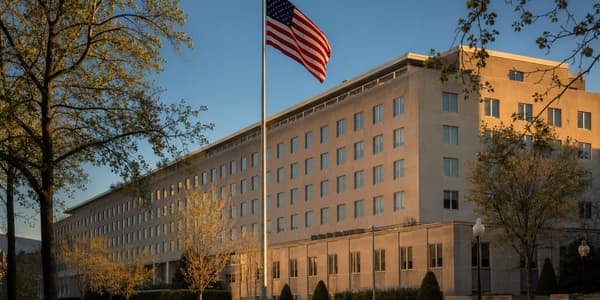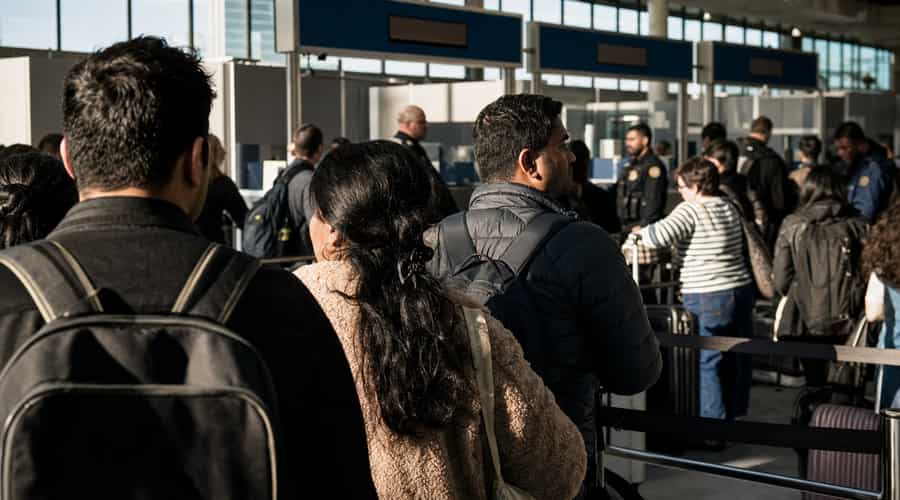
DHS Secretary Markwayne Mullin's threat to pull customs agents from airports in sanctuary cities has Senate Republicans rallying behind him, Democrats calling the idea "insane," and the travel industry warning of chaos ahead of the World Cup.
Markwayne Mullin is turning the nation's busiest international airports into leverage points in the administration's war on sanctuary cities. The Homeland Security secretary has threatened to pull Customs and Border Protection officers from airports in cities that refuse to cooperate with federal immigration enforcement, a move that would effectively shut down international arrivals at some of the country's most trafficked hubs. New York's JFK, Los Angeles International, Chicago O'Hare, Newark, San Francisco, Denver, Philadelphia, and Seattle are all on the administration's list of sanctuary jurisdictions, according to a roster the Department of Justice has published.
Mullin laid out the threat plainly during a May 26 Fox News appearance with Sean Hannity. "We're currently drawing up plans to say in these sanctuary cities where the local radical left Democrats aren't allowing us to do our jobs and enforce federal laws, then we shouldn't be processing international flights into their cities either," he said. That warning landed hard in the travel industry and set off weeks of heated debate in Washington.
Senate Republicans are broadly backing him. Sen. Lindsey Graham of South Carolina told Fox News Digital that the approach is exactly right. "I think there should be consequences to cities and states that undercut federal law," Graham said. "I think they should pay a price for what they do. I agree with what he's doing." Graham has separately introduced the End Sanctuary Cities Act of 2026, Senate Bill 3805, which would make it a federal crime for local officials to obstruct immigration enforcement and impose criminal penalties if a released migrant goes on to kill or seriously injure someone. Graham has been pushing for a floor vote tied to the DHS appropriations process.
Democrats gave Mullin a much colder reception at a Senate appropriations subcommittee hearing on June 2. Sen. Patty Murray of Washington called the airport proposal "insane," arguing that threatening to halt international arrivals over local immigration policy crossed a line, as the Philadelphia Inquirer and Local10 reported. Democrats also pressed Mullin on FEMA spending and broader DHS priorities. Mullin defended the administration's record and did not back down from the airport threat.
Within the Republican caucus, the support is real but not uniform. Sen. Ashley Moody of Florida said she needed to learn more about the specifics. Sen. Lisa Murkowski of Alaska said she was going to find out what was going on. Neither senator opposed the idea outright, but neither offered a full endorsement, suggesting Mullin will need to make his case before formal legislative action takes shape.
Friction Inside the Administration
The sharpest dissent has come from inside the administration itself. Transportation Secretary Sean Duffy told a congressional hearing that the idea does not make sense to him. "We shouldn't shut down air travel in a state that doesn't agree with our politics," Duffy said. Two Trump administration officials told CNN that the proposal is not being actively pursued internally, even as Mullin continues to raise it publicly. That gap between public warnings and internal planning has left airlines and airports in an uneasy position.
Airlines for America and the U.S. Travel Association have both condemned the idea. The U.S. Travel Association warned of devastating consequences for international tourism and the communities that depend on it, a concern amplified with the World Cup coming to the United States this summer. Pulling CBP officers from major hubs during a global sporting event would upend the arrival process for hundreds of thousands of visitors at exactly the wrong moment.
What remains undefined is the specific threshold of non-cooperation that would actually trigger a CBP pullback. Mullin has not laid out a clear standard for when a city crosses the line, and the administration has not published formal criteria. That ambiguity gives the threat its leverage, but it also leaves airports, airlines, and local governments without a clear path to compliance or conflict. Graham's legislation still needs committee action and a floor vote, and Mullin's executive threat remains, in the administration's own telling, a plan still being developed rather than imminent action. For cities that have spent years resisting federal immigration cooperation, the warning is growing harder to ignore.
Also read: Federal Judge Tosses Trump's $100K H-1B Visa Fee as Unconstitutional Tax • Houston ISD goes from 56 failing campuses to zero under state control • DOJ Targets 17 Naturalized Citizens in Largest Denaturalization Push Ever