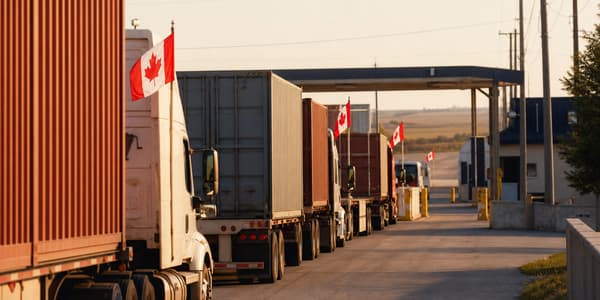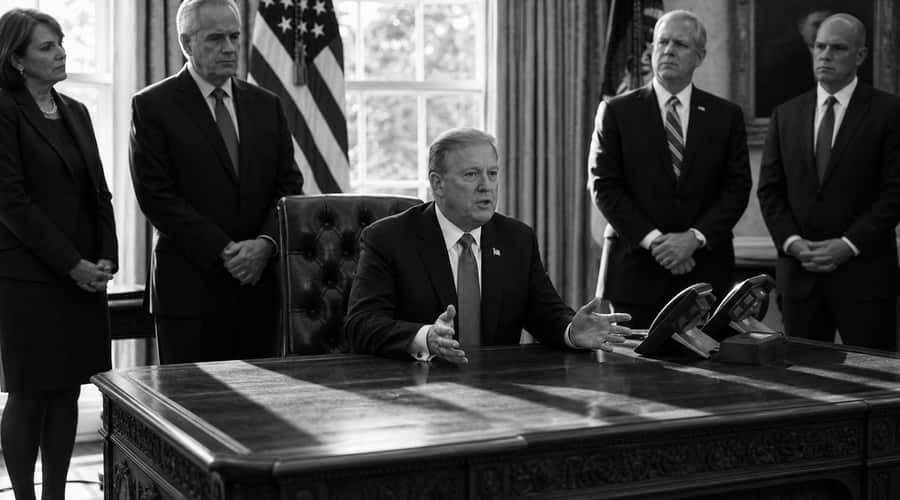
President Trump said he is not looking to renew the USMCA trade agreement ahead of the July 1 review deadline, opting instead to push separate bilateral negotiations with Canada and Mexico on his own terms.
President Donald Trump said Wednesday he is "not looking to renew" the United States-Mexico-Canada Agreement when the treaty's mandatory joint review arrives July 1, setting up what could be months of contentious renegotiation with both neighbors. Bloomberg and CBC News confirmed the Oval Office remarks, in which Trump added that the parties are still talking and "we'll see if we do something," leaving the door open while signaling no straightforward renewal is coming.
Trump framed the decision entirely around leverage. The United States, he said, doesn't need "anything that Canada has" or "anything that Mexico has," but both countries depend heavily on access to the American market. That asymmetry is exactly the point. He wants new terms, and he is prepared to let the review deadline pass without a renewal to get them.
The July 1 date was written into USMCA when Trump signed it during his first term. It triggers a mandatory joint six-year review, and if all three parties agree, they can extend the deal for 16 years, locking it in through 2042. Canada formally notified the U.S. and Mexico of its intention to seek that full extension on June 1, with Trade Minister Dominic LeBlanc traveling to Washington to make the case in person. Trump's answer, delivered publicly this week, was no.
Rather than trilateral talks, the White House has steered negotiations onto separate bilateral tracks. U.S.-Mexico discussions are already underway, with a third round scheduled for mid-July, Bloomberg reported. Canada's path forward is less structured. Mexican Economy Minister Marcelo Ebrard has stated publicly that Mexico prefers to keep USMCA intact as a three-country deal, but Washington is not offering that framework at the moment.
One of the U.S. priorities in those talks is raising the threshold for tariff-free treatment of new vehicles to at least 50 percent American content, a significant increase that would require automakers to shift supply chains away from Mexican and Canadian parts suppliers. The automotive sector accounts for roughly 22 percent of all trade under USMCA, according to Baker Institute data, making it the single largest segment of North American commerce covered by the deal. Any disruption to that supply chain reverberates immediately through factories in Michigan, Ohio, and Indiana.
Trump's posture fits squarely within the trade philosophy he used to replace NAFTA with USMCA in 2018: treat every agreement as a continuous negotiation, keep partners off-balance, and extract concessions by credibly threatening to walk away. Critics called it reckless the first time. He got a new deal anyway.
Economic Stakes and Political Exposure
The immediate practical effect of missing July 1 is more political than legal. Without renewal, USMCA enters rolling annual reviews but technically stays in force through 2036, unless one party exits entirely. That legal cushion limits the short-term damage. It does not eliminate the uncertainty, and uncertainty alone is enough to stall investment decisions in the auto and agricultural sectors that depend on predictable cross-border rules to plan years ahead.
Canadian Prime Minister Mark Carney has already characterized Trump's existing tariffs on Canadian steel and aluminum as violations of the agreement, according to CBC News reporting. LeBlanc and Canada's chief negotiator Janice Charette met with U.S. Trade Representative Jamieson Greer's team in Washington last week, and LeBlanc said afterward he left the meeting optimistic. The Carney government needs tariff relief and market access, but pressing too aggressively risks pushing Trump toward a bilateral arrangement that sidelines Canada altogether, an outcome far more damaging than any renegotiated terms.
Mexico has moved faster. Ebrard launched formal consultations with the Mexican private sector earlier this year, focusing on automotive, energy, and agriculture. Mexico's bilateral engagement with the U.S. is further along, and the country has more to offer in concessions given the scale of its export-driven manufacturing base. The risk is that a U.S.-Mexico side deal would fracture supply chains that cross all three borders and were built over three decades under the assumption of integrated North American production.
The next round of U.S.-Mexico talks arrives in mid-July, and July 1 will come and go without a renewal. What follows is the real negotiation. Whether Canada and Mexico ultimately accept terms weighted toward U.S. content requirements and American market conditions will define the shape of North American trade for the decade ahead.
Also read: Rideout Arsenal Leaves Virginia for Georgia After Spanberger Signs Gun Bans • Federal watchdog confirms Biden officials defied Title IX court order • Florida Supreme Court Clears Republican Map for 2026 House Elections