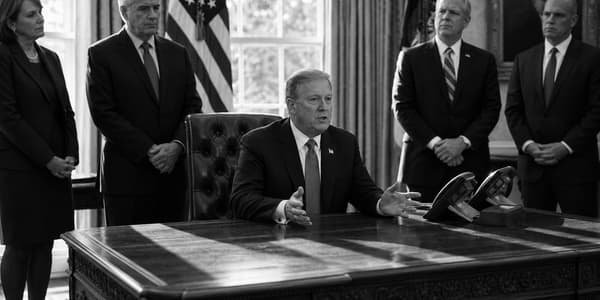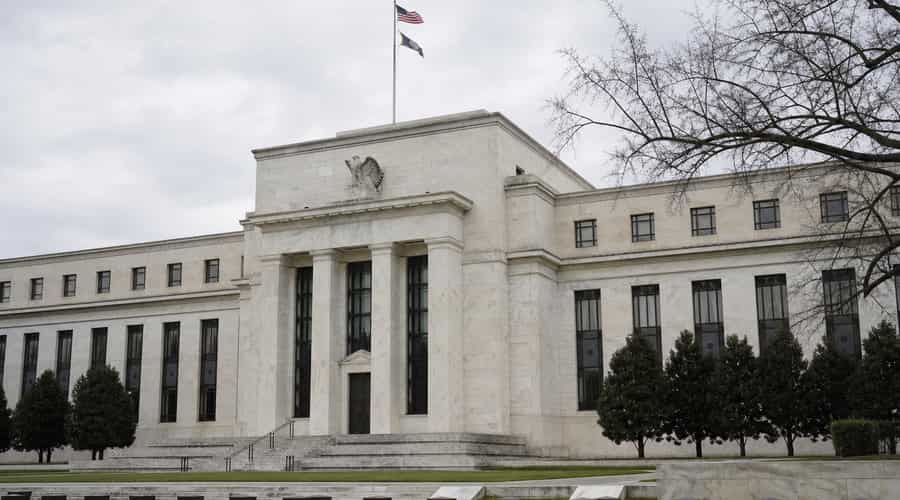
Kevin Warsh held his first Federal Reserve meeting Wednesday and immediately rewrote the rules, but the real news was nine officials signaling a rate hike before year-end amid inflation forecasts the Fed has not seen in three years.
The vote was 12 to 0 to hold the federal funds rate in its current range of 3.5% to 3.75%. Nobody was surprised by that. What caught attention was everything else.
The Fed's updated projections told a different story than the hold. Officials raised their 2026 headline inflation forecast to 3.6%, up sharply from the 2.7% they were projecting in March, the highest level in three years. Core inflation, which strips out food and energy, now sits at 3.3% in their estimate, also up from 2.7%. Nine of the 18 voting members now project at least one rate increase before the end of 2026, according to the updated dot plot. The median projection puts the federal funds rate ending the year at a midpoint of 3.8%, up from 3.4% in March. That is not a cut. That is a hike, and the committee is pointing squarely at it.
The inflation driving these revisions did not materialize from nowhere. Officials cited price pressures connected partly to the Iran war as a factor shaping their outlook. But the broader picture is one that has been building for years: the Federal Reserve is still cleaning up damage from an inflation surge that started well before anyone in that building wanted to admit it.
The statement itself was the starkest signal of how much is changing. Under Jerome Powell, Fed statements routinely ran past 300 words, loaded with conditional language, forward guidance, and layered clauses that gave markets something to trade on every meeting. Warsh's version came in at roughly 130 words. No vote breakdown. No color on inflation trends. No hint at where rates might go next.
Warsh addressed the absence of forward guidance directly at his post-meeting press conference. It was "not well-suited to the current policy conjuncture," he said. He also made an unusual personal disclosure: he declined to submit a forecast dot for the committee's dot plot, the quarterly chart that maps where each official thinks rates are heading. "I did not submit a dot for me," Warsh said. "It's not helpful in the conduct of policy."
That was a pointed departure from the Powell era, and a clear signal about what Warsh thinks previous leadership got wrong. He also announced five task forces to overhaul major Fed operations, focused on how the central bank communicates and conducts policy. Fed watchers described the combined moves as a regime change arriving in full on day one.
Markets absorbed the news with some turbulence. The S&P 500 was down roughly 0.2% in afternoon trading after the decision, while the Nasdaq and Dow finished little changed. Investors are not panicking, but they are repricing. A rate hike by year-end is now the baseline expectation, not a tail risk.
The Inflation Problem Has Not Gone Away
There is something instructive about the timing. Warsh is Donald Trump's pick, installed as chair after Trump spent years publicly pressuring Powell to cut rates faster. Trump has made clear he wants lower borrowing costs. The administration has a domestic manufacturing push and a political interest in keeping economic conditions loose heading into 2027.
And yet Warsh's first official act as chair is to preside over a committee where a majority of members are leaning toward a rate increase, not a cut. That tension is not lost on anyone following the Fed closely.
The inflation forecast revision is the heart of it. Going from 2.7% to 3.6% on the headline measure in three months is not a rounding error. It reflects an economy where price pressures have proven stickier than officials hoped, and where external shocks are adding new costs. The Fed's credibility on inflation is the whole ballgame for Warsh, and Wednesday showed he intends to treat it that way regardless of what the political calendar suggests.
The next FOMC meeting is scheduled for late July. Whether the inflation data between now and then gives the committee a reason to move, and whether Warsh's task forces produce anything concrete, will go a long way toward defining his tenure. The bet from nine of his own colleagues, right out of the gate, is that the next move on rates is up.
Also read: Federal Circuit lets Trump's 10 percent global tariff stand during appeal • Trump says the U.S. will not renew USMCA and pushes Canada and Mexico into bilateral talks • May inflation surges to 4.2%, the highest in three years on Iran energy shock