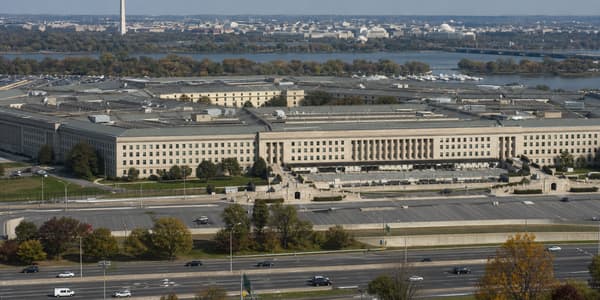
Defense Secretary Pete Hegseth visited Naval Station Guantanamo Bay on Wednesday, rallying U.S. troops and declaring the Pentagon prepared for "any possible contingency" as the Trump administration's maximum pressure campaign against Cuba's communist government reaches its most intense phase yet.
Hegseth stood before service members at the base and delivered a message he framed as coming from the top. "No matter what, the Department of War is going to be prepared and postured for any possible contingency," he told the troops, according to The Hill. President Trump, he added, "has got your back."
The visit, which also included a stop at MacDill Air Force Base in Tampa, home to U.S. Central Command, put the nation's top defense official 90 miles from the Cuban capital at a moment when Washington has made its intentions toward Havana about as explicit as they come. Trump has repeatedly threatened military force to topple Cuba's government, and the Pentagon's posture in the region has been shifting to match that rhetoric.
The administration's campaign against Havana has escalated at every level since January. The White House has imposed more than 240 sanctions on Cuban regime officials, according to a White House fact sheet released in May, targeting figures responsible for repression and what the administration calls threats to U.S. national security. The U.S. has blocked multiple oil tankers bound for Cuba this year through a combination of Coast Guard interdictions and an executive order threatening punitive tariffs on any country that supplies fuel to the island, cutting Cuba's energy imports by an estimated 80 to 90 percent according to observers tracking the crisis. Cuba confirmed in May that its diesel and fuel oil supplies had run dry, CNBC reported, a direct consequence of the pressure campaign that the administration has described as the most effective blockade of Cuba since the Cuban Missile Crisis.
The legal pressure has been equally aggressive. Former Cuban President Raúl Castro was indicted on May 20 by a U.S. grand jury on murder and conspiracy charges tied to the 1996 shootdown of two civilian aircraft belonging to Brothers to the Rescue, a Cuban-American exile group, according to reporting by CNN, CBS News, and NPR. Four men died in the attack, including three American citizens. The Trump administration unsealed the indictment on Cuban Independence Day, a deliberate signal. Havana condemned what it called a "despicable accusation" in a statement read on state television.
A Pattern of Senior Visits
Hegseth did not arrive at Guantanamo in a vacuum. He is the latest in a sequence of high-ranking U.S. officials to make the trip in recent weeks. CIA Director John Ratcliffe flew to Havana in mid-May for rare face-to-face meetings with leaders of Cuba's intelligence services, according to multiple accounts including NBC News and CBS News. General Francis Donovan, the commander of U.S. Southern Command, visited Naval Station Guantanamo Bay in late May and held an unusual discussion with a senior Cuban military officer at the base perimeter, CNN and Stars and Stripes reported. Shortly before that, the USS Nimitz carrier strike group arrived in the Caribbean, a deployment The Hill and Navy Times described as a clear show of force timed to the escalating U.S.-Cuba standoff.
The pattern of visits is not coincidental. Each sends a specific message: CIA means intelligence pressure, SOUTHCOM means operational readiness, a carrier strike group means sea control, and a defense secretary rally means the commander in chief's posture is wartime-serious. Together, they describe an administration that has moved Cuba from the margins of U.S. foreign policy to the front of the line.
Cuba's First Secretary Miguel Díaz-Canel confirmed in March that Havana had entered diplomatic talks with the United States aimed at addressing the energy blockade. That acknowledgment was itself a sign that the pressure campaign was producing some response. But the administration has given no indication it plans to ease up in exchange for talks alone, and Congress has not been publicly briefed on any formal shift in U.S. military posture toward the island.
The Trump administration has cast Cuba not as a tired Cold War antagonist but as an active security threat, pointing to Havana's alignment with Russia and Iran and its proximity to the U.S. coastline. Whether Hegseth's visit marks the high-water point of a pressure campaign that ends in negotiation, or one waypoint on a path toward something more direct, will likely become clear in the weeks ahead. The Pentagon, he made plain on Wednesday, is not waiting to find out.
Also read: Trump calls for short-term FISA extension as June 12 deadline looms • France and Germany scrap $116 billion fighter jet after nine-year impasse • Cotton urges DOJ to investigate Chinese campaign to sabotage U.S. AI