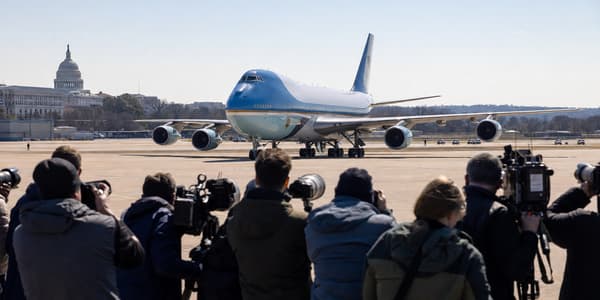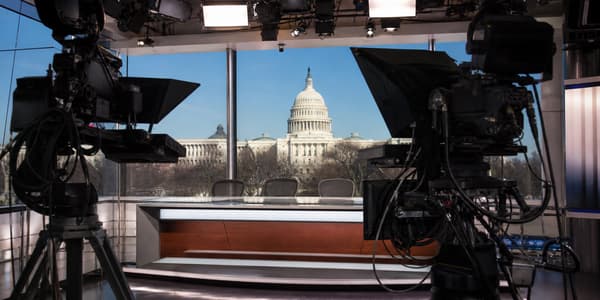
FCC Chairman Brendan Carr says ABC's refusal to air President Trump's election security address on broadcast television will be weighed in the agency's pending review of eight ABC-owned station licenses.
ABC and NBC pushed President Trump's July 16 primetime address on election security to their streaming platforms and kept their broadcast schedules untouched. CBS, Fox and the CW carried it live over the air. Six days later, FCC Chairman Brendan Carr told reporters the decision will not be forgotten when the agency reviews ABC's license applications.
"There's a real chance that decision gets scrutinized," Carr said at a Wednesday press conference, confirming an open proceeding to evaluate whether ABC's local stations have been operating in the public interest. The stations under review sit in New York, Los Angeles, Chicago, San Francisco, Houston, Philadelphia, Raleigh-Durham and Fresno, all owned and operated directly by the Disney-owned network.
Rep. Buddy Carter, R-Ga., sent the FCC a letter this week making the same argument in more direct terms. He wrote that ABC and NBC failed their public interest obligation by keeping millions of Americans from hearing a presidential address on the integrity of the voting system, delivered over airwaves the public technically owns. "The public airwaves should inform the American people, not be used by corporate executives to decide which matters of national importance they are permitted to hear," Carter wrote.
That is the crux of Carr's position too. Broadcasters hold their spectrum licenses on the condition that they serve the public interest, a standard baked into the Communications Act since 1934. Carr argues a sitting president addressing the nation on election security clears that bar easily. CNN, notably, didn't air the speech either, but CNN doesn't hold broadcast licenses subject to FCC review. ABC and NBC do, and that distinction is exactly why Carr's leverage applies to them and not the cable networks that skipped it.
Gomez calls it censorship
FCC Commissioner Anna Gomez, the agency's lone Democrat, isn't buying it. She told reporters the license review amounts to the government punishing a network for an editorial call protected by the First Amendment. "It is not for the FCC to tell broadcasters how to make their editorial decisions or what content to place on their networks or their local broadcast stations," Gomez said. She went further, calling the public interest standard "vague" and accusing the agency of using it "to punish speech this administration doesn't like, and to reward speech that it does like."
Gomez's objection tracks the broadcast industry's long-standing defense of editorial discretion, the same argument networks have made for decades when refusing to carry everything from presidential remarks to political ads. The counter from Carr's side is that editorial discretion has never meant immunity from the public interest test that licensees agreed to when they took a government-granted monopoly over a chunk of the airwaves. Nobody is stopping ABC from covering the speech, criticizing it or fact-checking it. The dispute is over whether ABC can decline to broadcast it live at all.
Trump made his own view plain during the speech itself, telling viewers ABC and NBC should lose their licenses over the decision. Carr has stopped short of endorsing that outcome directly, framing his comments instead around scrutiny within an already-scheduled review process rather than a standalone punishment. But the timing does the framing for him. ABC's license applications were already pending when the network chose to stream rather than broadcast a speech about protecting elections, and Carr has now made clear that choice is part of the file.
The review gives Carr real tools if he wants to use them. License renewals require FCC sign-off, and a chairman skeptical of a broadcaster's public interest record can slow-walk approval, demand additional filings, or refer the matter for a full commission vote. None of that guarantees ABC loses a license outright, a step the FCC has taken only rarely and never over a broadcaster's editorial choices. What it does guarantee is a drawn-out fight over how far the public interest standard reaches in an era when networks increasingly treat streaming as a substitute for broadcast obligations. Disney has not issued a detailed public response to Carr's comments. The FCC's review of the eight station licenses remains open, and no timeline for a decision has been set.
Also read: Jim Jordan refers Jack Smith to DOJ for lying to Congress about texts • Trump Approves Landmark Nuclear Cooperation Deal With Saudi Arabia • Trump hits Canada with new 50 percent tariffs over trade discrimination