Federal agents showed up at reporters' homes with grand jury subpoenas after the New York Times published an anonymously sourced story on Secret Service concerns over the Qatari-gifted Air Force One. The Times is fighting the order and calling it an attack on press freedom.
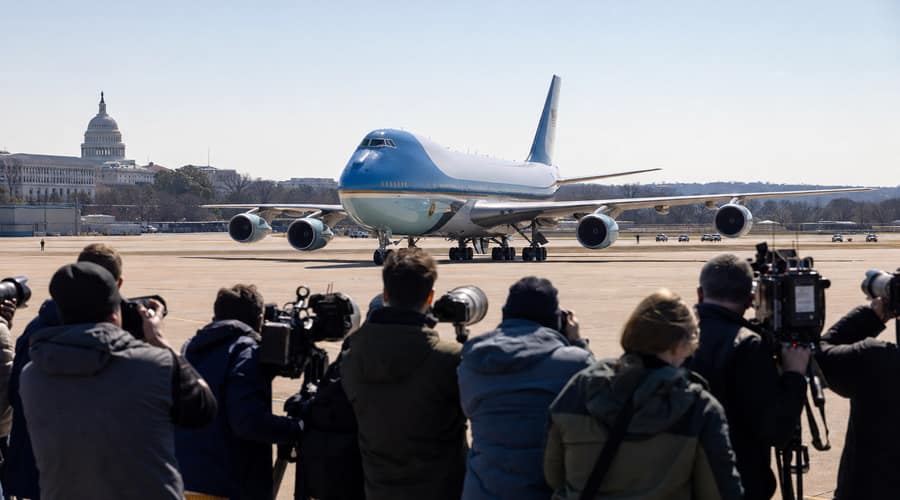
Four New York Times journalists, Julian Barnes, Eric Lipton, Tyler Pager and Eric Schmitt, have been ordered to testify before a federal grand jury in Manhattan after the Justice Department opened a leak investigation into who told them the Secret Service pushed President Trump to leave the NATO summit in Turkey on the older Air Force One rather than the new Boeing 747 gifted by Qatar. Federal agents delivered some of the subpoenas directly to the reporters' homes, according to CNN, CBS News, Fox News and NBC News.
The story that triggered the probe ran under the headline "Security Precaution Led Trump to Use Old Air Force One in Leaving Turkey." Citing unnamed sources, the Times reported the $400 million jet lacked defensive countermeasures built into the older plane, including advanced antimissile capabilities. Those are the kinds of details, drawn from sourcing the paper has never identified on the record, that a leak investigation exists to trace back to its origin inside government.
The subpoenas came days after FBI Director Kash Patel met with White House officials to discuss the bureau's investigation into who disclosed the security assessment, a meeting first reported by The Hill. That sequence matters. This is not the Justice Department telling the Times what it may print. It is the government trying to find the person, or people, inside its own ranks who handed a newspaper specifics about the security posture of the aircraft that carries the president of the United States. Whoever leaked that information did so anonymously and without authorization, according to the Times' own account of its sourcing, which remains unconfirmed and unverified outside the paper's reporting.
Presidents of both parties have gone after leakers with subpoenas before. The Obama administration secretly seized two months of phone records from more than 20 Associated Press phone lines in 2012 while hunting a leak tied to a foiled terror plot, and separately obtained the phone and email records of Fox News reporter James Rosen, whom a DOJ affidavit named a possible "co-conspirator" in a leak case, a label that drew sharp criticism even from press advocates sympathetic to Obama. Those episodes did not end the Republic. They ended with leakers identified and prosecuted, and with reporters, in both cases, protected from having to reveal their sources themselves. The current case follows a similar shape: a Manhattan grand jury, a hunt for the source, not a hunt to punish the newspaper for publishing.
The Times cries foul, and Trump fires back
David McCraw, the Times' senior vice president and deputy general counsel, did not hold back. "The appearance of Federal law enforcement agents on the doorstep of news reporters should shock the conscience of any American who believes in the Constitution and the press freedom it protects," McCraw said in a statement, calling the subpoenas "an attempt to prevent the public from knowing what is happening in their country by intimidating journalists from doing their jobs." The paper says it will contest the order in court.
Trump, for his part, has made no secret of his fury over the story, which embarrassed him by exposing that the $400 million jet Qatar gave his administration was not equipped to safely fly him directly home from a NATO summit. According to the New York Post, Trump lashed out at Democrats and the media over the coverage, branding the reaction to the plane story as the work of a press corps he considers reflexively hostile and a Democratic Party he has repeatedly labeled with the kind of harsh rhetoric that plays well with his base but draws fact-checks from mainstream outlets over its accuracy.
Adam Steinbaugh, a senior attorney with the Foundation for Individual Rights and Expression, warned that hauling reporters before a grand jury "sends a chilling message to journalists and whistleblowers alike," a concern worth taking seriously even for readers who think the leak itself deserves to be run down. Reporters are not typically the target of leak investigations; the leaker is. But subpoenaing four journalists at once, with agents at their front doors, is an aggressive posture that will draw legal fights over reporter's privilege regardless of who is in the Oval Office.
The grand jury testimony is set for this coming Wednesday in Manhattan, and the Times has signaled it intends to challenge the subpoenas before then. Watch for a motion to quash, and for whether the Justice Department is willing to name, even indirectly, who inside the government it believes handed reporters details about the president's own security.
Also read: Trump officials say Medicare transplant fraud crackdown saved billions • Toyota Puts $3.6 Billion Into Texas, Shifts Tacoma Work From Mexico • Trump says Walmart will cut ground beef prices nearly 15 percent