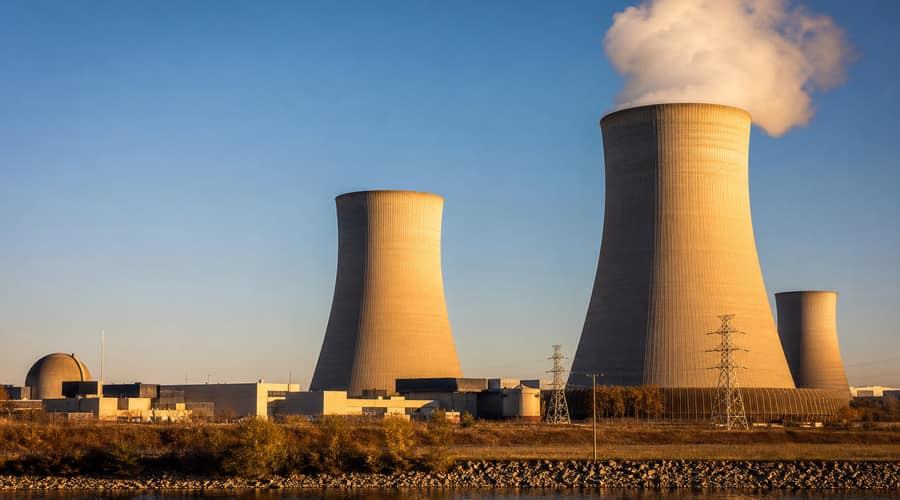
The Energy Department announced $17.5 billion in conditional loans on June 23 to build ten large nuclear reactors by the mid-2030s, driven by surging electricity demand from artificial intelligence data centers.
The number that matters most is not $17.5 billion. It is three. That is how many years Energy Secretary Chris Wright says these loans will shave off construction timelines for reactors that the country badly needs and has not been building. The announcement, made Monday, commits federal loan financing to five project sites, two reactors each, all using Westinghouse's AP1000 design. At 1.1 gigawatts per unit, each reactor can power more than 800,000 homes.
Wright framed the announcement plainly: America's electricity demand is rising faster than the grid can answer it, largely because of the breakneck buildout of AI data centers, and nuclear is the only baseload source that can close that gap on a meaningful scale. "This will help unleash the next American nuclear renaissance," Wright told reporters. The loans will not go to Westinghouse directly. Instead, the money flows to five special-purpose vehicles, each jointly owned by Westinghouse and a utility or energy company partner. To unlock the financing, each partner must put up nearly $1 billion in equity. Seven utilities have already signed letters of intent identifying candidate sites. Wright declined to name them or disclose locations, and the DOE has not yet finalized which five projects win the loans.
The loans come from the DOE's Office of Energy Dominance Financing, a designation that is deliberate. This administration's nuclear push is not wrapped in climate language. It is framed around grid reliability, national security, and industrial capacity. Trump signed four executive orders on nuclear energy after taking office, including one that ordered reform of the Nuclear Regulatory Commission and another that set a goal of quadrupling U.S. nuclear capacity to 400 gigawatts. The $17.5 billion commitment lands squarely inside that strategy: get ten reactors with complete, licensed designs under construction by 2030.
The AP1000 is the only large reactor design currently licensed to operate in the United States, which is precisely why Westinghouse's technology anchors the plan. The loans will fund long-lead-time components, the turbines, pressure vessels, and other hardware that typically take years to manufacture and deliver, and that have historically ballooned costs and stretched timelines on American nuclear projects. By fronting that financing early, the DOE aims to cut both.
The contrast with the Biden years is real, though not entirely clean. Biden's administration did back nuclear through the bipartisan ADVANCE Act of 2024 and supported a handful of individual projects, including a $1 billion loan to Constellation for the restart of the Crane Clean Energy Center in Illinois. But new large-scale construction stalled. No new AP1000s broke ground during his term. The regulatory environment remained slow, and private capital stayed cautious. Trump's team has moved more aggressively on permitting reform and is now applying the DOE loan office, which was built under Biden largely to finance renewables, to a nuclear buildout Biden never attempted at this scale.
What Comes Next
The five project sites will be selected from the seven utilities that signed letters of intent. That winnowing process has not started publicly, which means the states and communities that will host the new reactors are still unknown. Construction is targeted to begin by 2030, with the plants coming online in the mid-2030s. That is a long runway, and nuclear projects have a documented history of running long. The last AP1000s built in the United States, the two Vogtle units in Georgia, came in years late and billions over budget, a cautionary note that Wright and the industry will have to reckon with as partners commit equity and timelines harden.
Still, the scale of this announcement is different from anything that has moved through Washington in decades. Ten reactors. Five sites. $17.5 billion in federal financing. A target year of 2030 for groundbreaking. Whether the utility partners perform and the DOE's site selections hold up will determine whether this stays a headline or becomes a grid. The next milestone to watch is which seven utilities get named and which five make the cut.
Also read: Gas prices fall for third straight week as Trump's Iran deal cools oil markets • May inflation surges to 4.2%, the highest in three years on Iran energy shock • Supreme Court vacates ruling backing Biden gas furnace efficiency rules