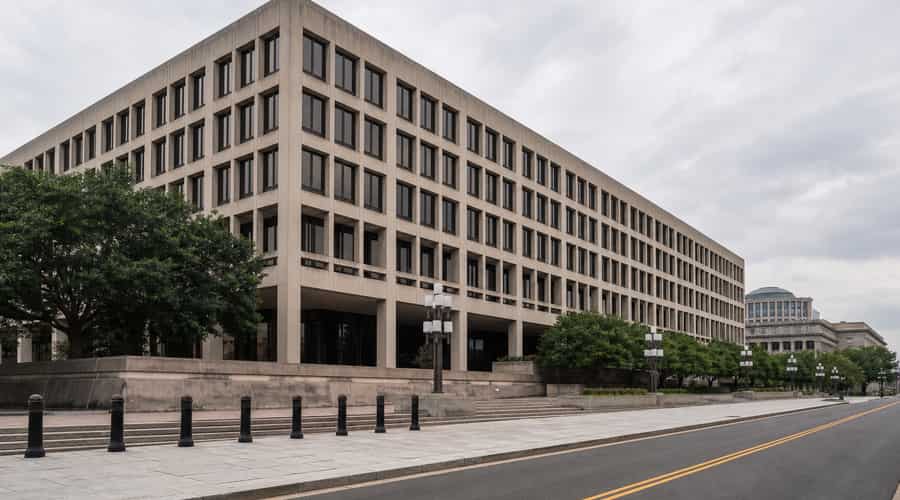
Acting Labor Secretary Keith Sonderling sent letters to all 53 governors Tuesday threatening to cut administrative funding unless states crack down on unemployment insurance fraud, a tool the department has never used before.
The warning is not theoretical. California owes the federal government more than $21 billion in fraudulent UI overpayments and borrowed funds, the largest single-state exposure in the country. New York is hemorrhaging an estimated $2 million every day to fraud and improper payments, with an improper payment rate that now exceeds 20 percent. These are not marginal accounting errors. They are the accumulated result of years of lax verification, outdated technology, and state governments that treated pandemic-era federal money as though accountability were someone else's problem.
Sonderling's letters, sent to executives across all 50 states and three territories, put the threat in writing: comply or lose the administrative dollars that keep state unemployment offices running. No Labor secretary has ever pulled that trigger. The fact that Sonderling is now formally placing it on the table signals a clear departure from the previous administration's posture of negotiating quietly and forgiving debts, a practice that drew bipartisan fire from Congress as recently as 2024.
The scale of what went wrong during the pandemic is staggering. The Department of Labor's own Office of Inspector General estimated that fraudsters, many operating from overseas, stole at least $76 billion from pandemic UI programs. The Government Accountability Office put the likely range between $100 billion and $135 billion. Either number represents one of the largest thefts of public money in American history.
In fiscal year 2025 alone, six states, California, Illinois, Massachusetts, New Jersey, New York, and Pennsylvania, collectively paid out more than $2.6 billion in improper unemployment benefits, of which over $1.2 billion was outright fraud. These are not obscure states with small programs. They are among the most populous and most politically prominent in the country, and most have been governed by Democrats throughout the period in question.
The DOL has already dispatched a specialized strike team to California to probe that state's unemployment insurance program. California's situation is particularly acute: beyond the fraud losses, the state borrowed heavily from the federal government to keep its UI fund solvent and has not repaid it, leaving taxpayers on the hook for interest payments that compound every year the principal sits unpaid.
Congress Moves to Extend the Clock
The executive pressure from Sonderling is running alongside a legislative push in Congress. The House passed the Pandemic Unemployment Fraud Enforcement Act, H.R. 1156 of the 119th Congress, on March 11, 2025. The bill doubles the statute of limitations for pandemic UI fraud from five years to ten, covering criminal charges including wire fraud and aggravated identity theft, as well as civil enforcement actions under the False Claims Act. The Senate has yet to take it up.
The timing matters. Many of the worst pandemic-era schemes date to 2020 and 2021. Under a five-year window, the clock on some of those cases was already running out. Extending it to ten years gives federal prosecutors the runway to pursue complex international fraud rings that took years to untangle in the first place. That is the logic behind the bill, and it is straightforward: the punishment should not expire before the investigation does.
The DOL has also been coordinating with its Office of Inspector General and with financial institutions, asking banks to freeze accounts linked to suspected fraudulent UI claims through December 31, 2026. That effort, launched in May, is meant to prevent funds from being moved or laundered while criminal referrals work their way through the system.
None of this recovers what was already lost. The $76 billion floor estimate from the OIG reflects money that is largely gone, transferred to foreign accounts, converted, and spent. What the current enforcement push can do is stop the bleeding in current-year state programs, claw back whatever is still traceable, and make clear to state administrators that the next round of federal generosity will not arrive without strings.
For California and New York specifically, the financial exposure is immediate. Losing administrative funding does not just sting politically, it disrupts the day-to-day operation of state unemployment offices at a time when neither state can easily absorb that kind of disruption. Governors who have spent years deflecting accountability for pandemic mismanagement now have a hard deadline and a named federal official willing to enforce it. Whether they act before the administration makes good on the threat is the story to watch.
Also read: Senate Republicans block Iran war powers resolution as peace deal nears signing • Trump beats Kemp's machine as Collins wins Georgia Senate nod • Federal grand jury indicts 15 Minneapolis antifa members in anti-ICE conspiracy