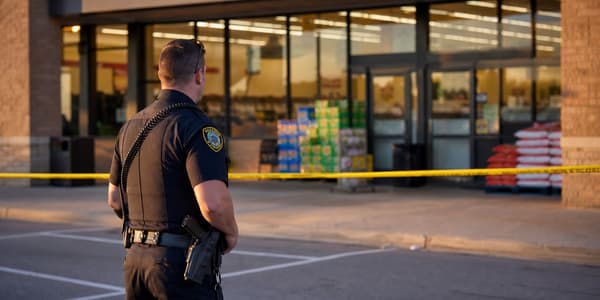
A Carencro, Louisiana father faces felony feticide charges after police say he slipped the abortion drug mifepristone to his 17-year-old pregnant daughter without her knowledge, forcing an emergency delivery that left a one-pound infant fighting for her life.
Jamelle Kelly, 39, was arrested Friday on two counts: attempted first-degree feticide and domestic abuse battery of a pregnant victim, according to the Carencro Police Department. The charges carry serious prison exposure under Louisiana's strict feticide statutes, which the state legislature sharpened in 2024 specifically to cover coerced chemical abortions.
Detectives first learned of the case on May 29, when they were told that Kelly's daughter, then 23 weeks pregnant, had been given medication intended to end her pregnancy without her knowledge or consent. She was rushed to a hospital, where physicians performed an emergency cesarean section. The infant, born weighing approximately one pound, remains hospitalized in critical condition and is expected to stay for an extended period, police said. Bond had not been set as of Friday.
The Carencro Police Department identified the drug as mifepristone, the first of the two-pill medication abortion regimen. Pro-life advocates have cited coerced administration of that drug for years in arguing against unmonitored access, and the Kelly case gives those arguments a specific and harrowing face.
Two years ago, a case like this might have gone largely unprosecuted. Louisiana changed that in 2024 when the legislature passed Act 246, which added mifepristone and misoprostol to the state's Schedule IV controlled substances list and created the specific crime of coerced criminal abortion by means of fraud, defined as knowingly using an abortion-inducing drug on a pregnant woman without her knowledge or consent and with intent to cause an abortion. The law handed prosecutors the precise charge they needed for the Kelly arrest.
States without equivalent statutes face a real gap. A person who did what Kelly is accused of doing in a state without a feticide law could face no charge that accounts for the unborn child, or at best a simple assault count. Louisiana built the legal architecture to respond to exactly this scenario, and it is now being used for the first time in a case this stark.
The Mail-Order Fight
The Kelly arrest lands in the middle of a live national battle over mifepristone access. Louisiana is a plaintiff in a federal lawsuit challenging the FDA's 2021 decision to allow the drug to be prescribed via telehealth and mailed directly to patients without an in-person medical visit. On May 1, a three-judge Fifth Circuit panel sided with Louisiana and reinstated the in-person dispensing requirement. The Supreme Court overrode that ruling on May 14, allowing mail-order access to continue while the litigation proceeds.
Pro-life groups and Louisiana's legal team have argued from the start that removing in-person oversight creates the exact conditions that produced the Kelly case: a drug capable of terminating a 23-week pregnancy is available by mail, with no physician examination at the point of dispensing and minimal tracking of who receives it. The arrest, coming less than a month after the Supreme Court's stay, is the sharpest real-world example those advocates have yet had to point to.
Rosalie Markezich, a Louisiana woman who says her former boyfriend obtained mifepristone online and coerced her into taking it, has already intervened in the Louisiana v. FDA litigation. Her case and the Kelly arrest follow the same logic: a third party acquires the pill, and the pregnant woman bears the consequences. Under the current FDA rules the Supreme Court left in place, that third party faces no oversight at acquisition.
Kelly's daughter had no say. Born at 23 weeks, her infant sits at the lower edge of viability, where survival rates are sharply uncertain and serious long-term complications are common even when a child survives. How the baby fares in the weeks ahead is not yet known.
Prosecutors in Lafayette Parish will determine whether additional charges apply. The Louisiana v. FDA case is expected to return to the Supreme Court after full Fifth Circuit briefing, and the facts of the Kelly arrest will almost certainly be cited by those arguing that pharmacy-by-mail mifepristone carries risks the FDA has not adequately addressed.
Also read: Armed Shoppers Stopped a Missouri Grocery Store Killer on Memorial Day • LA Republican DA alleges 81 percent of $5 billion abuse claims are fraud • NY Contractors to Pay $21.3 Million for Cheating Disabled Veteran Program