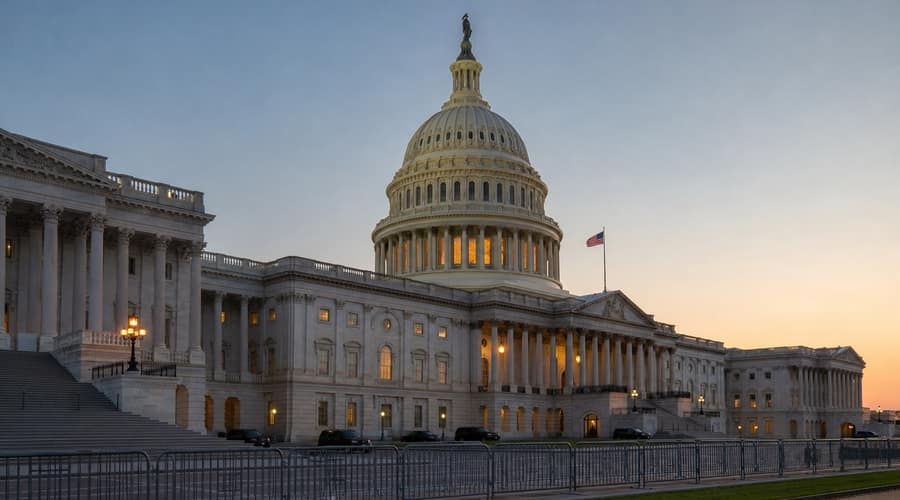
The House voted down a short-term FISA Section 702 extension, leaving the cornerstone of American foreign surveillance on the verge of its first-ever statutory lapse after Democrats refused to provide votes over President Trump's appointment of Bill Pulte as acting director of national intelligence.
The vote was 198 to 218, well short of the two-thirds majority required under the suspension-of-the-rules procedure House leadership used to bring the measure to the floor. Section 702, which authorizes warrantless collection of foreign targets' electronic communications and has been credited with disrupting major terrorist plots, is set to expire June 12 with no clear path forward. The House departed immediately for a scheduled week-long recess, not due back until June 23.
The collapse traced directly to Democratic opposition to Pulte, whom Trump appointed as acting director of national intelligence. Pulte led the Federal Housing Finance Agency before his elevation and carries no background in intelligence work, a fact Democrats made central to their argument. Rep. Jim Himes of Connecticut, the ranking Democrat on the House Intelligence Committee, stated the party's position without ambiguity. "One day under Bill Pulte is one day too many," Himes said, according to reporting from The Hill. Only seven Democrats broke with their party to support the short-term extension.
Nineteen Republicans also voted against the bill, driven by a mix of long-standing civil liberties objections and frustration with the broader political standoff. Some members have argued for years that 702's incidental collection of Americans' communications requires a warrant before agents can search it. In the Senate, an earlier attempt to advance the extension failed June 5 on a 47-to-52 vote, with seven Republicans joining Democrats in opposition, including Sens. Rand Paul of Kentucky, Josh Hawley of Missouri, and Mike Lee of Utah.
The stakes are not hypothetical. Intelligence officials have pointed to Section 702 as the authority that generated actionable intelligence used to disrupt a 2024 plot against Taylor Swift concerts in Vienna, Austria, according to the CIA. The program is the primary legal instrument for collecting communications of foreign targets, including suspected terrorists, weapons proliferators, and hostile foreign government operatives. Its defenders argue there is no substitute for the speed and scale it provides.
A statutory expiration would not immediately halt every surveillance operation. The Foreign Intelligence Surveillance Court approved certifications in March 2026 that authorize 702 collection through March 2027, and legal analysts say those certifications remain valid even if the underlying statute expires, according to analysis tracked by the Brennan Center for Justice. That grandfathering provision gives the intelligence community a legal cushion in the short term.
The sharper near-term risk falls on the telecommunications companies legally required to cooperate with government collection directives. A statutory lapse creates genuine uncertainty about whether pre-expiration directives remain binding after June 12, which could prompt some providers to reduce compliance until Congress clarifies the law. Even a brief gap in provider cooperation is the kind of vulnerability adversaries watch for and exploit.
Neither Side Is Moving
The Democratic strategy is a direct wager that Trump will remove Pulte or that political pressure will extract concessions on surveillance reforms. Trump signaled to Speaker Mike Johnson that he will not back down on Pulte, according to CNN, leaving no clear path to compromise. Johnson has not said publicly how he plans to address the lapse when the House returns June 23, eleven days after Section 702 is scheduled to expire.
The bind for Republicans is pointed. The party that has defined itself on national security for a generation is now watching a core counter-terror authority expire, not for lack of votes to support the program but because Democrats chose to use it as leverage in a personnel dispute with the White House. Whether enough pressure accumulates in both chambers to force a resolution before the lapse produces real intelligence consequences will become clear in the days ahead.
Also read: Russia Hacked Rep. Don Bacon's Signal Account, FBI Is Investigating • DOJ and FBI seize 13 Chinese-linked sites that targeted US clearance holders • Eight indicted in alleged yearlong intimidation drive against U-M over Israel