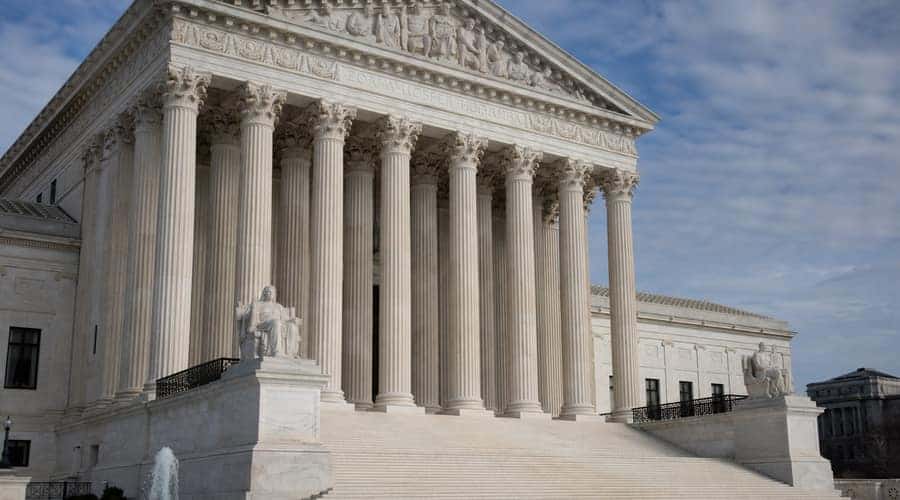
The Supreme Court vacated a lower-court ruling that upheld Biden-era efficiency mandates for gas furnaces and water heaters, ordering a federal appeals court to take a fresh look in light of the Trump administration's argument that the rules rest on a legal error.
In a short order issued Monday, the justices directed the D.C. Circuit Court of Appeals to reconsider its earlier decision "in light of the position" taken by the Trump administration's Department of Justice. The move, known as a GVR (grant, vacate, and remand), does not decide the underlying legal merits of the rules. But it signals that the challengers' arguments carry enough weight to warrant fresh judicial review, and it effectively pauses Biden's appliance agenda pending that reconsideration.
At stake are two sets of rules finalized under the Biden Department of Energy: a standard requiring residential gas furnaces to meet at least 95 percent annual fuel utilization efficiency, set to take effect December 18, 2028, and commercial gas storage water heater rules requiring 95 percent thermal efficiency that kick in as early as October 2026. The American Gas Association, which brought the challenge under case number 25-879, argued that both rules effectively eliminated non-condensing appliances from the market, not by banning them outright but by setting efficiency thresholds only condensing models can meet.
The practical burden on homeowners is central to the industry's case. Non-condensing furnaces, which account for roughly 55 percent of the natural gas furnace market nationwide, vent exhaust gases through traditional vertical chimneys. Condensing furnaces, the only kind that clears the 95 percent standard, produce cooler exhaust and require PVC piping routed horizontally through an exterior wall, along with a condensate drainage line. For a homeowner whose house relies on chimney-based venting, the switch is not simply a matter of buying a new furnace. It means a new venting installation typically costing $800 to $1,200 or more, a condensate drain, and in many cases a visit from a building inspector.
The American Gas Association told the Court in filings that the Biden rules "eliminate non-condensing gas furnaces and commercial water heaters, which work with the chimneys and natural-draft venting already in millions of American homes and businesses." That argument found a receptive audience in the Trump DOJ. Solicitor General John Sauer filed a brief on April 28 telling the justices that the Department of Energy now considers the rules to rest on a "legal error," specifically an incorrect reading of the Energy Policy and Conservation Act, which bars the agency from setting standards that effectively eliminate a product with distinct performance characteristics from the market.
The Department of Energy is currently conducting a review of whether the efficiency mandates impose an "undue burden" on domestic energy resources, according to the Washington Examiner. That review, launched under the Trump administration, runs parallel to the renewed court challenge and could result in the rules being rescinded before the D.C. Circuit issues a new decision.
A Broader Pattern of Appliance Rollbacks
Monday's order fits a recognizable pattern. The Biden administration used the DOE's appliance-standards process to push fuel-switching goals across multiple product categories, including dishwashers, air conditioners, and gas ranges. Courts and the Trump DOE have been unwinding those rules one by one. The Biden DOE had argued the furnace standards would save Americans $1.5 billion annually in utility bills, a figure critics at the Competitive Enterprise Institute and the Institute for Energy Research called unverified and based on modeling assumptions that ignored the upfront conversion costs shouldered by individual homeowners.
The American Gas Association was joined in its Supreme Court petition by the American Public Gas Association, the National Propane Gas Association, and a coalition that grew to more than 34 organizations asking the DOE to reverse what they called an effective ban on widely used products. The Trump DOJ's decision to side with the challengers rather than defend the prior administration's work was the direct trigger for the Court's GVR order.
The case now returns to the D.C. Circuit, which must weigh the Solicitor General's position that the rules rest on a legal error under federal energy conservation law. If the appeals court agrees, the efficiency mandates could be vacated entirely. If it reaffirms them, the litigation will almost certainly return to the Supreme Court for a full merits hearing. For the millions of homeowners who heat with non-condensing gas furnaces, the outcome is concrete: it determines whether replacing a worn-out furnace stays a simple swap or triggers a costly overhaul of the home's entire venting infrastructure.